

Brighter Futures area
Where is the Brighter Futures area?
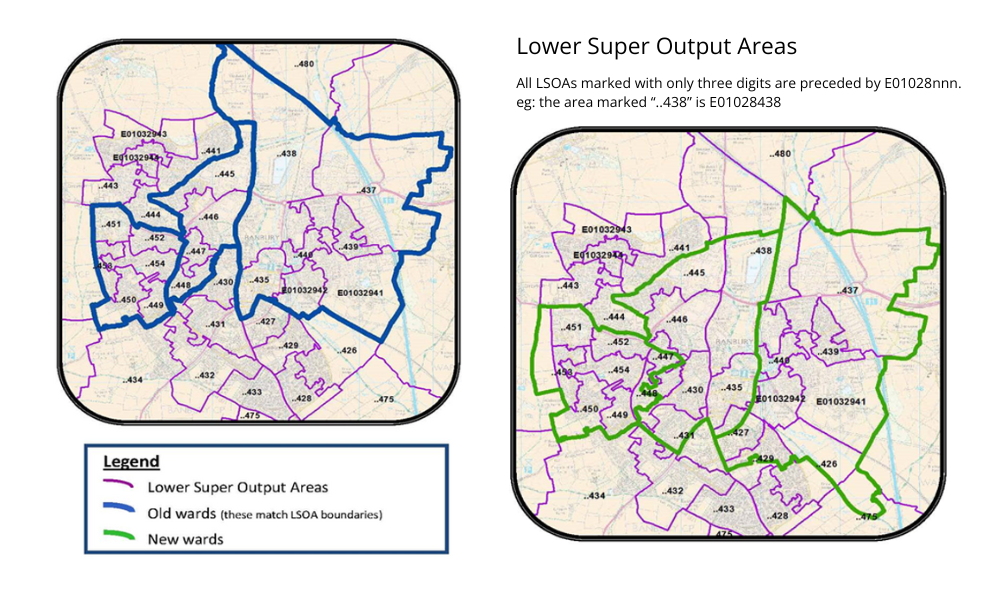
The term “Brighter Futures area” is used to cover three wards in Banbury, North Oxfordshire - Grimsbury, Neithrop and Ruscote.
Banbury Grimsbury and Hightown ward is in north-east Banbury and the area covers the Grimsbury housing estate, the industrial and retail area north of Hennef Way, the junction with the M40 motorway, Thorpe Way Industrial Estate and the railway station to the south.
Ruscote and Neithrop wards are in North Banbury. Both are bordered to the north and west by the ward of Hardwick and south by the ward of Easington. Neithrop is adjacent to Grimsbury ward and Ruscote to the parish of Wroxton.
Where people are born, live, grow, work, and get older has the biggest influence on health and health inequalities.
Lower Super Output Areas
Reasons for working there
The three wards which form the Brighter Futures all have distinct characteristics, but they have in common that each of the wards has levels of deprivation in the worst 20% nationally. This affects the quality of life of the residents, and their health and life expectancy.
People living in poverty find it harder to live healthy lives, harder to access NHS services, live with greater illness and die earlier than the rest of the population. (Source: Kings Fund Report)
Cost-of-living issues
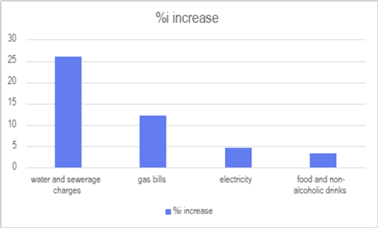
We have not seen as many headlines about the cost-of-living crisis recently, but the issue of high prices and the inability of people on low incomes to afford the essentials has not gone away.
Inflation has continued to rise with no sign of prices falling to their previous levels or incomes rising to a level which would compensate for the price rises.
(source: ONS):
Some household bills rose sharply in the year to April 2025
- water and sewerage charges
- gas bills
- electricity
- food and non-alcoholic drinks
There is a wealth of evidence that shows the strong links between deprivation and poor life chances.
Poverty and the effect it has on health and on the NHS is not new, though the recent rise in deep poverty, cost-of-living increases and high pressure on NHS services are all worsening the problem (6 in 10 people in the most deprived areas report that the cost-of-living squeeze is impacting their health) and adding to the financial cost to the NHS.
The NHS has a role to play in addressing poverty, both as an employer and as a provider of public services. There are examples of good work under way, such as poverty-proofing services (making sure every stage of the patient pathway is accessible to more deprived groups), but more needs to be done to support better access and better outcomes for those living in poverty.
The NHS can only treat the symptoms of poverty; broader government, economic and civic society action is needed to treat the causes. (Source Illustrating the relationship between poverty and NHS services report to the Kings Fund: The Relationship Between Poverty And NHS Services | The King's Fund_
Banbury Grimsbury has double the Oxfordshire average of children living in poverty (23% vs 11%) and higher than Oxfordshire average of children eligible for free school meals (24% vs 16%). (Source: Oxfordshire County Council Community Insight Profiles)
The Pace of Change in areas of Deprivation
There have recently been questions in academic circles about the lack of change in some areas of deprivation in the UK, despite funding and services being directed there over some time. The Joseph Rowntree Trust looked at this question and concluded that areas of deprivation have felt the effect of falling living standards which have affected the whole population. We have looked in previous reports into the ways in which people on low incomes are more adversely affected by rising prices, because they have much smaller disposable incomes and therefore less “wriggle room” - it is not possible to economise if you can already only afford the basics.
It is 20 years and counting since we last saw a prolonged period of falling poverty. Taking a longer view, we can see that overall poverty barely changed during the Conservative-led Governments from 2010 to the latest data covering 2022/23. The last period of falling poverty was during the first half of the previous Labour administration (between 1999/2000 and 2004/05), but it then rose in the second half of its time in power.
In part, the lack of progress over the last 20 years reflects the series of hits to living standards that have affected the whole population. Each of the 5 Parliaments since 2005 has recorded lower quarterly income growth than the last 13 Parliaments before 2005, stretching back to the start of available data in 1955. This started with the economic slowdown even before the global financial crisis and persisted through the crisis itself, then austerity, Brexit, the coronavirus pandemic and finally the cost-of-living crisis. (Source: Joseph Rowntree Trust UK poverty report 2025 - UK Poverty 2025: The essential guide to understanding poverty in the UK | Joseph Rowntree Foundation).
Individual vs. Area Dynamics
While an area may appear static on paper, there can be significant changes at the individual level, with people moving in and out of poverty and the area itself. This complexity must be considered to tailor effective policies for persistent deprivation
Oxfordshire – a Marmot County - and Brighter Futures’ place in it
The Marmot Place Programme
Oxfordshire County Council has partnered with the UCL Institute of Health Equity to become a Marmot Place. This means a commitment to tackling health inequalities and improving health fairness in Oxfordshire by working with local partners across the system. These include local authorities, communities, public services, businesses, and voluntary sector organisations.
The Brighter Futures Partnership is a strong supporter of Oxfordshire County Council’s ambition to make our county a “Marmot Place” - this is fundamentally the same agenda as the Partnership’s own ambition to break cycles of deprivation and enable individuals and communities to thrive. The most deprived areas of Oxfordshire have in many ways the most to gain from this approach.
A Marmot Place recognises that health and health inequalities are mostly shaped by the social determinants of health (SDH): the conditions in which people are born, grow, live, work and age, and takes action to improve health and reduce health inequal.
About the programme
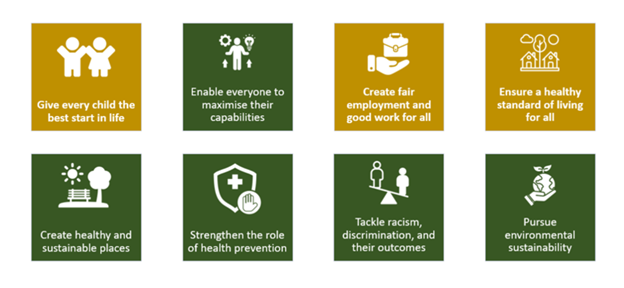
The programme aims to create a fairer and healthier Oxfordshire and is initially focusing on three of the eight Marmot Principles:
- Give every child the best start in life
- Create fair employment and good work for all
- Ensure a healthy standard of living for all
Oxfordshire County Council states that at the heart of this work are the charity and voluntary organisations across the county that work tirelessly in our communities, making a real difference in helping tackle inequalities.