

About this Strategy
2.0 Legislative Background and Government Policy
The Government’s main policy statement on contaminated land is now contained within a DEFRA guidance document: Environmental Protection Act 1990, Part 2A: Contaminated Land Statutory Guidance, April 2012 (‘the Statutory Guidance’). The principles of this have also been incorporated into the Communities and Local Government document “National Planning Policy Framework” as revised and published in February 2019.
UK policy on land contamination as set out in the Framework, as well as emphasising the Government’s commitment to the environmental principles of “sustainable development” and “the polluter pays”, requires that existing contamination which poses a threat to health or to the environment is controlled and treated within the “suitable for use” approach. The statutory basis of the regime is to be found in Part 2A of the Environmental Protection Act 1990 (which was inserted by the Environment Act 1995).
2.1 Part 2A Objectives
The overarching objectives of the Government’s revised policy on contaminated land are:
(a) To identify and remove unacceptable risks to human health and the environment.
(b) To seek to ensure that contaminated land is made suitable for its current use.
(c) To ensure that the burdens faced by individuals, companies and society are proportionate, manageable and compatible with the principals of sustainable development.
2.2 The Requirement for a Strategic Approach
All local authorities are required to take a strategic approach to the identification of land in their area that merits detailed individual inspection. The Statutory Guidance requires that the approach adopted should be rational, ordered and efficient and it should reflect local circumstances. The local authority should set out its approach as a written strategy, which it should formally adopt and publish, and which should be reviewed periodically.
The Statutory Guidance details the elements which should be included in the strategy.
2.3 Definition of Contaminated Land
Section 78A(2) of the Environmental Protection Act defines contaminated land as follows:
“any land which appears to the local authority in whose area it is situated to be in such a condition, by reason of substances in, on or under the land, that
a) significant harm is being caused or there is a significant possibility of such harm being caused; or
b) pollution of controlled waters is being, or is likely to be, caused
With respect to controlled waters, the Water Act 2003 amended the second limb of the definition so that it applies only where "significant pollution of controlled waters is being caused, or there is a significant possibility of such pollution being caused". This change in the legislation became effective as of 6 April 2012.
The presence of a contaminant in land does not of itself mean that it is contaminated land within the meaning of Part 2A. The Statutory Guidance refers to Contaminant Linkages where one or more contaminant pathway receptor linkages exist.
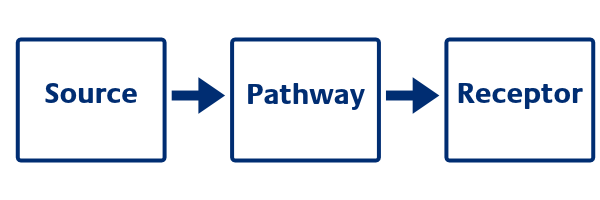
Receptors are defined as:
something that could be adversely affected by a contaminant, for example a person, an organism, an ecosystem, property, or controlled waters.
Detailed definitions of the types of receptors are set out in Section 4 of the Statutory Guidance. The Statutory Guidance also refers to “significant contaminant linkages”, referring to those that give rise to a level of risk sufficient to justify a piece of land being determined as contaminated land.
The local authority has the sole responsibility for determining whether any land appears to be statutory contaminated land within its area.
Since the enactment of the contaminated land legislation, significant progress has been made in many technical areas of assessment and remediation of contaminated land.
2.4 The concept of a pollutant linkage
As indicated above, the definition of contaminated land includes the notion of ‘significant harm’ and the ‘significant possibility’ of such harm being caused. In determining what is significant, the Council will have regard to statutory guidance issued by the Secretary of State.
The statutory guidance uses the concept of a ‘pollutant linkage’, i.e. a linkage between a source of contamination and a receptor by means of a pathway. Prior to determining that any land appears to be contaminated land on the basis that significant harm is being caused, or that there is a significant possibility of such harm being caused, the Council will identify a significant pollutant linkage comprising each of the following:
- a contaminant
- a relevant receptor
- a pathway by means of which either the contaminant is causing significant harm to the receptor or there is a significant possibility of such harm being caused
Pollutant linkages should be represented by a conceptual model for the site, which can either be in a diagrammatic form or tabulated, and shows the possible relationships between contaminants, pathways and receptors. The conceptual model (a diagram showing the relationship between sources, pathways and receptors for a site) is important throughout the whole process of risk assessment and should be refined as more information is gathered about a site.
The Council will also act in accordance with statutory guidance issued by the Secretary of State in determining whether pollution of controlled water is being, or is likely to be, caused. Prior to determining that any land appears to be contaminated on the basis that pollution of controlled waters is being, or is likely to be, caused, the Council will have identified a significant pollutant linkage where controlled waters constitute the receptor.
2.5 Risk assessment
In order to determine whether there is the possibility of significant harm being caused, local authorities must consider the nature, extent and duration of contamination and assess the susceptibility of nearby receptors.
The Council will carry out an appropriate scientific and technical assessment, following the Model Procedures for the Management of Land Contamination (CLR11), produced by the Environment Agency and Department for Environment, Food and Rural Affairs (DEFRA). This is a technical framework for structured decision-making and reflects the Government’s policy on how risks from land contamination should be managed. Other peer-reviewed scientific and technical guidance will be applied as appropriate.
The basic approach to risk assessment involves identifying the hazards (i.e. contaminant sources), assessing these in terms of pollutant linkages and the likely consequences, and then estimating the risk (i.e. predicting the magnitude and probability of those possible consequences). There are three tiers in the risk assessment process:
a) Preliminary Risk Assessment (desk study, site history, conceptual site model, qualitative risk assessment)
b) Generic Quantitative Risk Assessment (intrusive investigation, compare site data to generic assessment criteria, refine risk assessment)
c) Detailed Quantitative Risk Assessment (derive site specific assessment criteria for key pollutant linkages, refine risk assessment further to determine remedial measures).
2.6 Categorisation of Contaminated Land
In deciding whether land is contaminated land on grounds of significant possibility of significant harm to human health, the Council will follow the system of categorisation in the Statutory Guidance. For each receptor, the guidance details four categories.
Categories 1 and 2 would encompass land that is capable of being determined as contaminated land on grounds of significant possibility of significant harm to human health. Categories 3 and 4 would encompass land which is not capable of being determined on such grounds. A further description of the categories will be found in Table 2.1.
Uncertainties arise in allocating land to Categories 2 and 3. The government recognised that regulatory authorities may have difficulties in assigning land to Categories 2 and 3 and has appointed, through DEFRA, a panel of experts from industry and local authorities to assist local authorities in making decisions with regard to these uncertainties. That panel is now disbanded but detailed decisions made by the panel in cases submitted to it have been made available.
Category 4 Screening Levels (C4SLs) were published in 2014 which have been developed to help decide when land is suitable for use and not statutory contaminated land. Soil Guideline Values (SGVs) and other Generic Assessment Criteria (GACs) are well within Category 4 and present minimal risk. The C4SLs are set at the top of Category 4 and although still precautionary, their purpose is to speed up the decision-making process for regulators. They are also very likely to act as a suitable remediation target for the development of brownfield land.
When considering whether significant harm is being caused, or there is a significant possibility of such harm being caused, to non-human receptors, Local Authorities should pay regard to Tables 1 and 2 of the Statutory Guidance.
2.7 Roles and Responsibilities
This Strategy has been reviewed with particular reference to the 2012 DEFRA guidance, and the Council has adopted the following approach:
Regulatory Services and Community Safety has been identified as the lead service within the Council for the purpose of the Strategy, in consultation with other services including Planning and Development, Planning Policy, Building Control, and Legal Services, as appropriate, and external agencies including the Environment Agency, Natural England, DEFRA, landowners, and agents.
The Environment Agency also has four main roles:
- To assist local authorities in identifying contaminated land (particularly where water pollution is involved);
- To provide site specific guidance to local authorities on contaminated land where requested;
- To act as enforcing authority for contaminated land designated a ‘special site’;
- To publish periodic reports on contaminated land.
Where the presence of contaminated land has been confirmed the enforcing authority must:
- Establish who should bear responsibility for remediation;
- Decide after consultation what must be done in the form of remediation and ensure it is effectively carried out;
- Determine liability for the costs of the remedial works;
- Maintain a public register of regulatory action in relation to contaminated land.
Regulatory Services and Community Safety will ensure that, as far as possible, land contamination is dealt with through the planning system or by voluntary remediation on the part of the current landowner. To date all sites have been dealt with in this way.
Requests for service and enquiries from members of the public regarding potentially contaminated land will normally be responded to within 3 working days, except where pollution incidents are occurring, in which case it will be responded to on the same day